
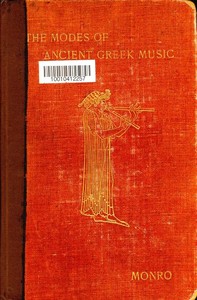
The Modes of Ancient Greek Music by D. B. Monro
Let's be clear from the start: this isn't a novel. There's no protagonist in the traditional sense, unless you count D.B. Monro himself as he guides us through the evidence. The 'plot' is his investigation. For centuries, scholars knew the ancient Greeks wrote extensively about their music's power. They believed different musical scales, called 'modes,' could directly shape your character. The Dorian mode was for soldiers—steady and manly. The Lydian mode was too soft and relaxing, maybe even corrupting. Plato wanted to ban certain modes from his ideal Republic!
The Story
Monro takes these ancient descriptions, which are like reading a car manual for a vehicle that no longer exists, and tries to reverse-engineer the engine. He compares confusing Greek terms, analyzes fragments of musical notation, and wrestles with centuries of scholarly guesses. The central drama is whether we can ever truly understand what these influential modes were. Is our modern musical thinking so different that we're forever lost? Monro methodically presents the clues, argues with other experts (including his own father, a noted Homeric scholar!), and builds his best possible case. The journey is the destination.
Why You Should Read It
I loved this because it changed how I think about everyday things. We treat music as entertainment or art, but the Greeks saw it as a technology for the soul, as fundamental as law or education. Monro's work shows the sheer intellectual ambition of trying to grasp a lost world. You feel the frustration and the occasional 'aha!' moment right alongside him. It makes you appreciate that some historical mysteries aren't about finding buried treasure, but about recovering a lost way of thinking.
Final Verdict
This is a niche book, but a fascinating one. It's perfect for history buffs who enjoy deep dives into specific topics, or for musicians curious about the philosophical roots of their art. It's also great for anyone who likes smart, clear writing about complex ideas. If you approach it as an armchair archaeological dig, you'll be rewarded. Just don't expect a light beach read—have a cup of coffee ready and prepare to have your mind stretched in the best way possible.
This is a copyright-free edition. Use this text in your own projects freely.
Robert Moore
1 year agoJust what I was looking for.







Joshua Wilson
10 months agoAs someone who reads a lot, the storytelling feels authentic and emotionally grounded. Exceeded all my expectations.