
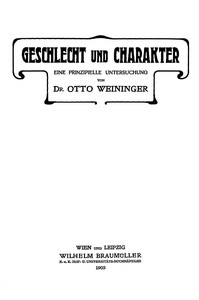
Geschlecht und Charakter: Eine prinzipielle Untersuchung by Otto Weininger
Let's be clear from the start: Otto Weininger's 'Sex and Character' is not a novel. There's no plot in the traditional sense. Instead, think of it as a young man's frantic, obsessive attempt to build a philosophical fortress out of his own anxieties. The 'story' is the argument itself. Weininger, only 23, sets out to define the fundamental natures of masculinity and femininity, not as social roles, but as metaphysical principles he calls 'M' and 'W.' He claims every person is a blend, but that women are almost entirely 'W'—incapable of genius, logic, or true moral sense, existing only in relation to sexuality and men. Men, however, can aspire to pure 'M,' which means genius, creativity, and ethical existence. The book's climax isn't an event; it's his conclusion that the highest calling is for men to reject the 'feminine' within themselves and for humanity to move beyond women entirely. It's a deeply unsettling and circular argument, fueled by a startling mix of biology, philosophy, and pure prejudice.
Why You Should Read It
You don't read this book to agree with it. You read it to understand a dangerous way of thinking. It's like holding a live grenade of early 20th-century ideology. The sheer confidence with which Weininger builds his hateful system is breathtaking. It shows how intellectual brilliance can be twisted by fear—fear of women, fear of sexuality, and ultimately, fear of oneself. The tragic biography of Weininger, who took his own life shortly after publication, hangs over every page, making it a shocking case study of how personal torment can dress itself up as universal truth. Reading it made me angry, sad, and deeply thoughtful about how ideas of gender are constructed and weaponized.
Final Verdict
This is not a book for everyone. It's certainly not for anyone looking for a progressive take on gender. It's essential reading for students of intellectual history, philosophy, or the roots of misogyny. If you're interested in the dark, twisted ideas that floated around Vienna in 1900 and later influenced some of the century's worst ideologies, this is a primary source. Approach it with critical guardrails up. Read it as a warning, a pathology, and a monument to a troubled mind. It's a difficult, offensive, but historically significant book that will challenge you to think about why some ideas, no matter how ugly, manage to captivate and endure.
This content is free to share and distribute. You can copy, modify, and distribute it freely.




Donna Moore
2 years agoSurprisingly enough, the narrative structure is incredibly compelling. Worth every second.