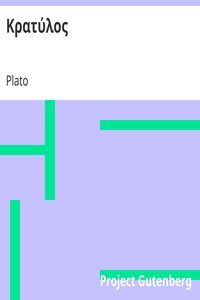
Κρατύλος by Plato
So, what's actually happening in this ancient Greek chat? Picture a sunny day in Athens. Socrates runs into two friends, Hermogenes and Cratylus, who are locked in a fierce disagreement. Hermogenes argues that names are purely conventional—we could call a 'horse' a 'dog' if everyone agreed. There's no natural link. Cratylus, a follower of the philosopher Heraclitus (who believed everything is in constant flux), takes the hard opposite stance. He believes names are inherently correct, given by a divine lawgiver, and perfectly capture the essence of the thing itself. Get the name wrong, and you can't truly know the thing.
The Story
Socrates, playing referee, launches into a massive investigation. For most of the dialogue, he entertains Cratylus's theory. He takes apart Greek words—gods, elements, virtues, even letters of the alphabet—and invents imaginative, often humorous, origins to show how their sounds might mirror their nature. 'Astron' (star) comes from 'astrape' (lightning flash) because stars are fiery? Sure! But then he starts poking holes. If names are perfectly natural, why are there synonyms? Why do languages differ? The conversation twists and turns, ultimately leaving both theories looking a bit shaky. Socrates suggests that maybe we shouldn't rely so heavily on words to find truth; we need to study the things themselves. The dialogue ends inconclusively, with Cratylus stubbornly clinging to his belief and Socrates walking away, leaving us to think.
Why You Should Read It
Don't let the 'philosophy classic' label scare you. This book is a blast because it's so human. You get Socrates at his most playful and mischievous, making up stories about words like a witty, ancient linguist. It's fascinating to see people 2,400 years ago wrestling with the exact same questions that keep linguists and philosophers up today: Is there a 'right' way to label the world? How much does our language shape our reality? Reading it feels like eavesdropping on the world's first, and one of the best, debates about memes, slang, and cultural meaning before any of those things existed. It makes you look at everyday language in a completely new light.
Final Verdict
This one's perfect for the curious reader who loves ideas, wordplay, or ancient history but wants something different from the usual epic battles or tragedies. It's not a straightforward narrative; it's an intellectual sport. You'll need a translation with good notes (those Greek word puns are key!). If you enjoy podcasts about the origins of language, deep dives into how we think, or just the spectacle of a great thinker having fun with a seemingly simple question, you'll find 'Cratylus' surprisingly fresh and endlessly thought-provoking. It's a short, challenging, and wonderfully weird trip into the Athenian mind.
This historical work is free of copyright protections. Preserving history for future generations.
Michael Robinson
1 year agoSurprisingly enough, the arguments are well-supported by credible references. I couldn't put it down.
Matthew Harris
11 months agoFast paced, good book.
Thomas Davis
3 months agoWithout a doubt, the depth of research presented here is truly commendable. I couldn't put it down.
Betty Clark
4 months agoThanks for the recommendation.



Joseph Thompson
2 months agoNot bad at all.