
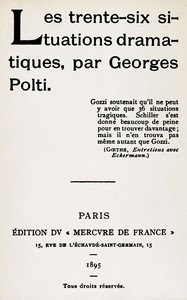
Les trente-six situations dramatiques by Georges Polti
Forget everything you know about a typical book review. 'Les trente-six situations dramatiques' isn't a story you follow from page one. Instead, think of it as a field guide, or maybe a recipe book, for drama itself. Published in 1895, French writer Georges Polti set out on a mission to prove a stunningly simple idea: all human drama, across all of history and fiction, is built from just 36 fundamental scenarios.
The Story
There's no protagonist here except Polti's own theory. The book is structured as a list. Each of the 36 situations gets its own chapter with a title like 'Supplication,' 'Deliverance,' 'Crime Pursued by Vengeance,' or 'The Enigma.' For each one, Polti provides a definition, breaks it down into possible character roles (like 'the Persecutor' or 'the Unrecognized Savior'), and then floods the page with examples. He pulls from Greek tragedies, Shakespeare, French classical theater, and even some contemporary works of his time to show how 'Adultery' or 'Fatal Imprudence' plays out again and again. The 'plot' is watching him build his case, example by ancient example, that our storytelling is both endlessly creative and strangely repetitive.
Why You Should Read It
This book is a brain-tickler for story lovers. Reading it is less about absorbing a narrative and more about playing a game. You'll start spotting Polti's situations everywhere—in the news, in the movie you watched last night, in that podcast you love. It makes you see the skeleton beneath the skin of every tale. Is his list perfect or complete? Probably not. Scholars have debated it for over a century. But that's part of the fun. You get to argue with a 19th-century Frenchman about storytelling! It’s a short, dense read that will permanently change how you watch, read, and think about stories.
Final Verdict
This is a niche gem, but a brilliant one. It's perfect for writers, screenwriters, and hardcore story analysts looking for a structural toolkit. It's also great for curious readers and film buffs who enjoy peeking behind the curtain to see how the magic trick works. If you love talking about 'tropes' or the 'hero's journey,' this is the great-granddaddy of those ideas. Just don't go in expecting a novel. Go in expecting a fascinating, slightly obsessive, theory that will stick with you long after you've finished the last of the thirty-six entries.
This digital edition is based on a public domain text. Knowledge should be free and accessible.
Deborah Smith
4 months agoSurprisingly enough, the arguments are well-supported by credible references. I will read more from this author.
Charles Williams
1 year agoPerfect.
Kenneth Brown
1 year agoWithout a doubt, the depth of research presented here is truly commendable. I would gladly recommend this title.
Anthony Jackson
1 year agoThe index links actually work, which is rare!




Paul Perez
1 year agoLoved it.