
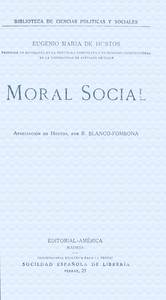
Moral social : apreciación de Hostos by Eugenio María de Hostos
Let's be clear from the start: this isn't a novel with a plot. 'Moral Social' is Hostos's blueprint for a better world. Written in the late 1800s, it comes from a place of deep personal struggle. Hostos was an exile, fighting for Caribbean independence from colonial powers. He saw that political freedom was empty without a foundation of shared ethics and social justice.
The Story
There's no traditional storyline. Instead, Hostos builds his case like an architect. He starts with the individual, explaining that our personal morality—being honest, kind, responsible—is just the first brick. The real structure, the 'social morality' of the title, is built when we extend those principles to our community and nation. He connects ethics directly to education, arguing that to create free citizens, you must first teach them to think critically and care for others. The entire book is his argument that a nation's strength doesn't come from its army, but from the character and solidarity of its people.
Why You Should Read It
I'll be honest, some passages feel of their time, but the core message is shockingly current. When Hostos talks about the duty we have to each other, or how injustice anywhere weakens society everywhere, it echoes conversations we're having right now. His passion is contagious. You can feel his frustration with inequality and his burning hope that people can choose a better path. It’s less about abstract philosophy and more about practical, daily choices that build a fairer community. Reading it made me think about my own responsibilities beyond my front door.
Final Verdict
This book is perfect for anyone interested in the roots of social justice, Caribbean history, or political philosophy that feels human and grounded. It's also great for readers who enjoy primary sources—hearing a historical figure's voice directly, without a textbook filter. If you're looking for a fast-paced narrative, this isn't it. But if you want a compelling, thought-provoking essay from a true believer in human potential, give Hostos an hour of your time. You'll come away with plenty to talk about.
This content is free to share and distribute. It is now common property for all to enjoy.
Edward Lewis
1 year agoUsed this for my thesis, incredibly useful.
John Lee
1 year agoClear and concise.
Amanda Martin
1 year agoNot bad at all.
Jackson Johnson
6 months agoPerfect.





Karen Lopez
1 year agoGreat read!