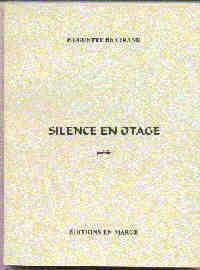
Silence En Otage: Poésie by Huguette Bertrand
Silence En Otage (Silence Held Hostage) isn't a book with a plot in the traditional sense. It's a collection of poems written by Huguette Bertrand when she was very young, first published in the 1940s. But if there's a story here, it's the internal journey of a voice learning to speak through—and against—silence. The poems act as small, intense windows into moments of reflection, longing, and restraint.
The Story
Think of it less as a narrative and more as a series of emotional snapshots. Bertrand uses simple, precise language to explore what happens when feelings become too large for words. The 'hostage' is that unspoken tension—the love you can't confess, the grief that has no outlet, the observations about the world that you keep to yourself. Each poem is an attempt to negotiate with that silence, to release a little piece of it into the world. There's a sense of a young woman grappling with her interior life against the backdrop of her time, finding power in naming the quiet things.
Why You Should Read It
I picked this up on a whim, and its clarity stunned me. In an age of constant noise, there's something radical about poetry that honors restraint. Bertrand doesn't shout; she whispers, and you have to lean in to listen. That makes the experience feel intimate, like you're being let in on a secret. The themes are timeless: the gap between feeling and expression, the weight of memory, the quiet resilience in simply observing the world. It's not 'difficult' poetry; it's accessible, but it leaves room for you to bring your own silence and find echoes within it.
Final Verdict
This is a perfect book for anyone who thinks poetry isn't for them, because it's so direct and free of pretense. It's for the quiet observer, the person who feels things deeply but doesn't always have the words. If you enjoy authors like Louise Glück or the early, sparse work of Sylvia Plath, you'll find a kindred spirit here. Keep it on your nightstand. Read one or two poems before bed. It's a small book that asks big questions about what we hold inside and what we set free.
This publication is available for unrestricted use. It is now common property for all to enjoy.
Emily Wilson
1 year agoWithout a doubt, the content flows smoothly from one chapter to the next. One of the best books I've read this year.
Robert Lopez
1 year agoThis is one of those stories where it creates a vivid world that you simply do not want to leave. One of the best books I've read this year.
Susan Rodriguez
1 year agoI came across this while browsing and it provides a comprehensive overview perfect for everyone. Exactly what I needed.
Ava Sanchez
1 year agoThe formatting on this digital edition is flawless.
Aiden Perez
1 year agoRecommended.