
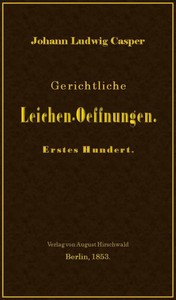
Gerichtliche Leichen-Oeffnungen. Erstes Hundert. by Johann Ludwig Casper
Let's clear something up right away: this isn't a novel. Gerichtliche Leichen-Oeffnungen (Forensic Autopsies) is exactly what it says on the tin—a century-old compilation of 100 autopsy reports. But calling it just a medical journal misses the point completely. Dr. Johann Ludwig Casper was the chief forensic pathologist in mid-1800s Berlin, and his work helped lay the groundwork for modern crime scene investigation.
The Story
There's no single plot. Instead, the book is a series of short, intense vignettes. Each chapter details a specific body that arrived on Casper's table. He describes what he sees: the color of the skin, the state of the organs, the strange marks or substances found. Then, he becomes a detective. Using the science available to him—chemistry tests for poisons, analysis of wound patterns, observations of decomposition—he works backward to determine the cause and manner of death. The cases range from tragic industrial accidents and drownings in the Spree River to suspected infanticides and blatant homicides. You follow his logic as he debunks family lies, confirms grim suspicions, and occasionally, uncovers a truth no one expected.
Why You Should Read It
The power here is in the perspective. You're not reading a historian's summary or a novelist's dramatization. You're getting the direct, clinical notes from the man in the room. It's stark and often graphic, but that rawness is what makes it so compelling. You see the early, clumsy steps of forensic science—the wrong assumptions, the brilliant deductions, the limitations of the era. More than that, through these 100 anonymous bodies, you get a haunting social portrait of 19th-century Berlin: its poverty, its violence, its dangers, and the quiet, meticulous work of one man trying to bring justice to the forgotten.
Final Verdict
This book is not for the squeamish. The descriptions are detailed and clinical. But if you love true crime, medical history, or social history, it's a unique and fascinating read. It's perfect for anyone who watches shows like Bones or CSI and wonders, "How did they even start figuring this stuff out?" Think of it as a primary source document that reads like the most grounded, sobering mystery series you've ever encountered. Just maybe don't read it right before dinner.
This digital edition is based on a public domain text. It is now common property for all to enjoy.


Christopher Martinez
1 year agoThe formatting on this digital edition is flawless.